
Orangeburg County Release Meaning
A release record marks the point when one custodian gives up control. It does not always mean a person walked into the community without limits. Orangeburg County Detention Center may release someone after bond, dismissal, time served, sentence completion, or another court order. The same facility may transfer a sentenced person to the South Carolina Department of Corrections, move someone on an outside warrant, or deliver a person to federal or immigration custody. Each event removes the name from ordinary Orangeburg County jail visibility, but only some are community releases.
The most accurate statement names the agency. “Orangeburg County custody ended” is narrower and safer than saying someone is free. Ask what happened next. The destination may be the community, SCDC, another jail, a supervision office, or another government custodian. The county booking and release sheet is the main administrative record for a local jail episode. A court order explains the legal authority, while VINE may report the custody event. Those sources answer related questions, yet none should be stretched beyond what it proves.
Orangeburg County Release Types
Release terms describe both the authority and the next legal status. Bond can end pretrial custody while the charge remains open. Time served means the custodial part of a sentence has reached its endpoint. Probation may be imposed with or without a prison term. Parole is conditional release from an eligible state sentence. Community supervision is a distinct South Carolina status for certain no-parole sentences. A transfer is different because government custody continues.
| Release type | What it means | Best next check |
|---|---|---|
| Bond or recognizance | A court authorized pretrial release, subject to conditions and clearance of other holds. | Bond order, jail out time, and case docket |
| Dismissal or not guilty | The listed case no longer supplies a basis for custody, though another hold can remain. | Court disposition and jail release sheet |
| Time served or completion | The custodial term ended for that sentence. | Sentencing record and actual release entry |
| Parole or probation | Custody may end while legal supervision continues. | SCDPPPS offender search and county office |
| Community supervision | State prison custody ended under a separate statutory supervision category. | SCDC release result and SCDPPPS record |
| Transfer | Another agency assumed custody. | Receiving agency locator and destination field |
- Discharge
- The formal end of a custody or supervision status as defined by the responsible agency.
- Time served
- Credit or service that satisfies the custodial part of a sentence.
- Detainer
- A request or legal basis for another agency to hold or receive the person.
- Expungement
- A court-driven process that can remove qualifying public arrest and case material under state law.
These labels should be copied as the source states them. For example, the SCDC released search has shown RELEASED, PROBATION, and COMMUNITY SUPV. They are not interchangeable. A PROBATION result establishes that state custody ended under that release label, but it does not show that all legal control ended.
Note: Preserve the exact release type because agency labels distinguish community departure, supervision, sentence completion, and transfer to another custodian.
Orangeburg County Release Record Fields
For a local jail event, ask for the booking/release sheet, jail-card entry, or equivalent record kept by the Orangeburg County Sheriff’s Records Division. A request should identify the person and booking period, then name the fields needed. Asking only for “information” invites an answer that no custom research is required under FOIA. Asking for a known record gives the custodian a concrete target.
- Booking number and admission time: connect the release to the correct custody episode and its start.
- Arresting agency and charges: tie the booking to the agency and case.
- Bond and court number: point to the legal file and release authority.
- Actual release date and time: record when Orangeburg County custody ended.
- Release manner or code: states bond, completion, transfer, or another agency term.
- Receiving agency or destination: distinguishes community release from continued custody elsewhere.
- Booking photograph: may be requested separately, subject to access law and agency review.
Does a court order prove the exact release time? No. It proves judicial authority or disposition. Jail processing and unresolved holds can create a gap before the actual out time, so compare the order with the detention record.
Orangeburg County has not published a verified online release-detail schema or archive period. Do not substitute fields claimed by a commercial roster. The official record may also be narrowed by juvenile rules, privacy exemptions, sealing, or expungement.
Request Orangeburg County Release Records
The Sheriff’s FOIA channel is the direct route for detention records. The published form requires requester contact details, a specific record description, incident details when known, fee instructions, a signature, and a government-issued identification copy. Legal representatives must include original proof of representation. State a reasonable fee ceiling because an open agreement to pay is treated by the form as authorization up to $250.
- Give the full legal name, date of birth if known, booking or incident number, arresting agency, and a narrow date range.
- Ask for the booking/release sheet and separately request the related booking photograph if needed.
- Name the actual out date and time, release manner, authorizing order, and receiving agency or destination as desired fields.
- Choose electronic delivery where practical, set a fee ceiling, sign the request, and attach the required identification.
- Send it to Sheriff Records by the form’s listed mail, fax, or email route, then retain the request and response together.
P.O. Drawer 9000
Orangeburg, SC 29116-9000
Phone: 803-533-5943
Fax: 803-533-5806
Email: crandolph@orangeburgcounty.org
The Sheriff form lists $5 per incident report plus applicable search, review, and duplication costs. It does not give a separate booking-photo price. The county’s general FOIA form is an alternate route for county administrative records and permits email, mail, pickup, or paper delivery. Its fee schedule uses actual labor at the rate of the lowest-paid qualified employee. Electronic records already available for direct email carry no copy charge, though other costs can still apply.
Under South Carolina FOIA, Title 30 Chapter 4, an agency generally makes its initial determination within 10 business days, or 20 business days for records more than 24 months old. That deadline concerns the initial response, not always final production. A deposit cannot exceed 25 percent of anticipated cost. Exempt or sealed material may be withheld or redacted.
Note: Request the destination field because “released” in a jail system can describe a transfer that continued custody with another agency.
When Orangeburg Bond Leads Release
Orangeburg Bond Court posts a specific local schedule. Hearings are held daily from 9:00 a.m. to 2:30 p.m. Bonds may be paid or posted at the Central office on weekdays from 8:30 a.m. to 5:00 p.m. Those hours help identify when legal and payment steps can occur. They do not establish the minute when the detention center finishes release processing.
A bond order is only one link in the chain. Staff must receive and apply the authority, complete the required checks, and determine whether another warrant, detainer, or agency hold exists. For that reason, ask Bond Court or the case file about authorization, then ask the detention center for actual out time and destination. If another custodian took the person, the Orangeburg record should be read as a transfer rather than a walk-out release.
Note: Bond authorization can precede physical release, so pair the court record with the jail’s actual out time and destination.
Orangeburg Release Records After Expungement
The First Circuit Solicitor operates an Orangeburg expungement program at 151 Docket Street. Its published charges are separate: $250 for the solicitor’s administrative fee, $35 for the Clerk filing fee, and $25 for SLED verification. Eligibility depends on the case and statute. Many convictions cannot be expunged. A pardon marks a conviction as pardoned but does not erase it.
South Carolina Code Section 17-1-40 requires destruction of public arrest and booking material after a qualifying disposition and expungement. Covered material can include associated warrants, fingerprints, and mugshots. Law enforcement and detention agencies may retain sealed material for three years and 120 days, or longer for certain investigations, litigation, complaints, or inquiries. Thus, a past record can lawfully disappear from public view. Its absence does not prove the booking never occurred.
For a record that may be sealed or expunged, use the court and agency process that applies to the person’s own matter. Do not try to reconstruct protected material from stale copies. The current order and the response from the official custodian control public access.
Find Orangeburg County Released Inmates
Start with the custody type, not one broad name search. A recent local arrest belongs to the Orangeburg County Detention Center and the correct county or municipal court. A state prison sentence belongs to SCDC. Active community supervision belongs to SCDPPPS. Federal prison belongs to BOP, while immigration detention belongs to ICE. Mixing them can turn a transfer into a false claim of community release.
- Call the detention center with a full name and matching date-of-birth or booking detail. Ask whether Orangeburg County still has custody.
- If custody ended, ask for actual date and time, release manner, and destination or receiving agency.
- Check SC VINE for the Orangeburg facility event, while treating the alert as notification rather than a certified sheet.
- Search the South Carolina Judicial Branch case gateway by name or case number and select the right Orangeburg court.
- If SCDC received the person, use its current custody search and separate released-person search for their distinct purposes.
- Use SCDPPPS for active supervision, or the federal and immigration locator tied to the last custodian.
- For proof or an older county event, request the booking/release sheet from Sheriff Records.
Older events rely more on documents than live systems. Court dockets and a narrow date range improve a records request. The BOP locator covers federal prisoners from 1982 to the present, while older federal prison records may require the National Archives. A sealed or expunged result may not appear at all.
Note: Match a common name with booking number, SCDC number, SID, case number, birth information, and consistent dates before combining records.
SCDC Orangeburg Release Search
South Carolina uses two separate SCDC tools. The ordinary SCDC inmate search covers people currently sentenced to and incarcerated in SCDC as of midnight the prior day. Its stated scope excludes released prisoners, county jail detainees, people on parole or probation, people on community supervision, and SCDC fugitives. It is useful when an Orangeburg County detainee may have transferred into state prison, but it is not the archive for discharged state prisoners.
The SCDC Released Inmate Search is the actual state-release channel. It requires beginning and ending release dates, offers ORANGEBURG in the county selector, and includes an optional sex-offender filter. Results can show SCDC ID, name, sex, race, age, release date, release type, and county. Exported data adds SID, victim and detainer indicators, and an offense-description field. The capture below comes from that official SCDC application and shows the date-and-county search structure.
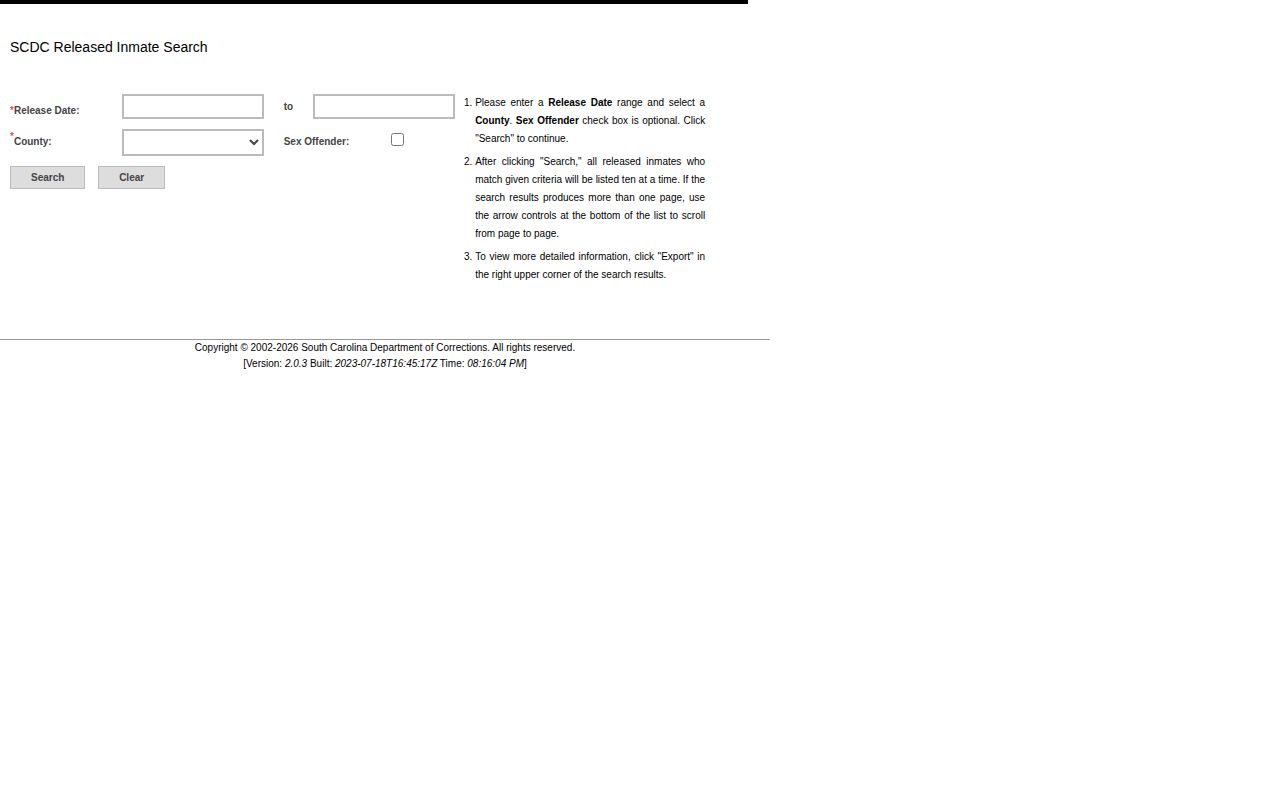
The interface matters because it is a date-and-county search, not a former-inmate name search. The Orangeburg county field identifies the county associated with the SCDC release or destination; it does not prove the person was ever held at the Orangeburg County Detention Center. Search a bounded range, export identifiers, then reconcile the result with SCDPPPS and the sentencing record.
| SCDC channel | Inputs | What it can establish |
|---|---|---|
| Current inmate search | SCDC number, SID, first or last name, phonetic option | Current state incarceration and the live detail fields |
| Released inmate search | Required date range, county, optional sex-offender filter | Actual SCDC release date, type, county, and export identifiers |
| Victim Services inquiry | SCDC number, SID, or name | Current location and projected release dates |
Does an SCDC Orangeburg result prove county-jail release? No. It documents departure from SCDC. County jail release must be verified through the Orangeburg detention record.
Orangeburg Release Supervision Checks
SCDPPPS tracks active probation, parole, community supervision, and supervised reentry. Its official offender search accepts set combinations of first name, last name, SID, county, and year of birth. Results reflect the prior day, and people who are no longer under supervision may not be listed. For same-day status, contact the county office that supervises the person, which may differ from the county of conviction. The image below shows the official SCDPPPS interface recorded for Orangeburg release research.
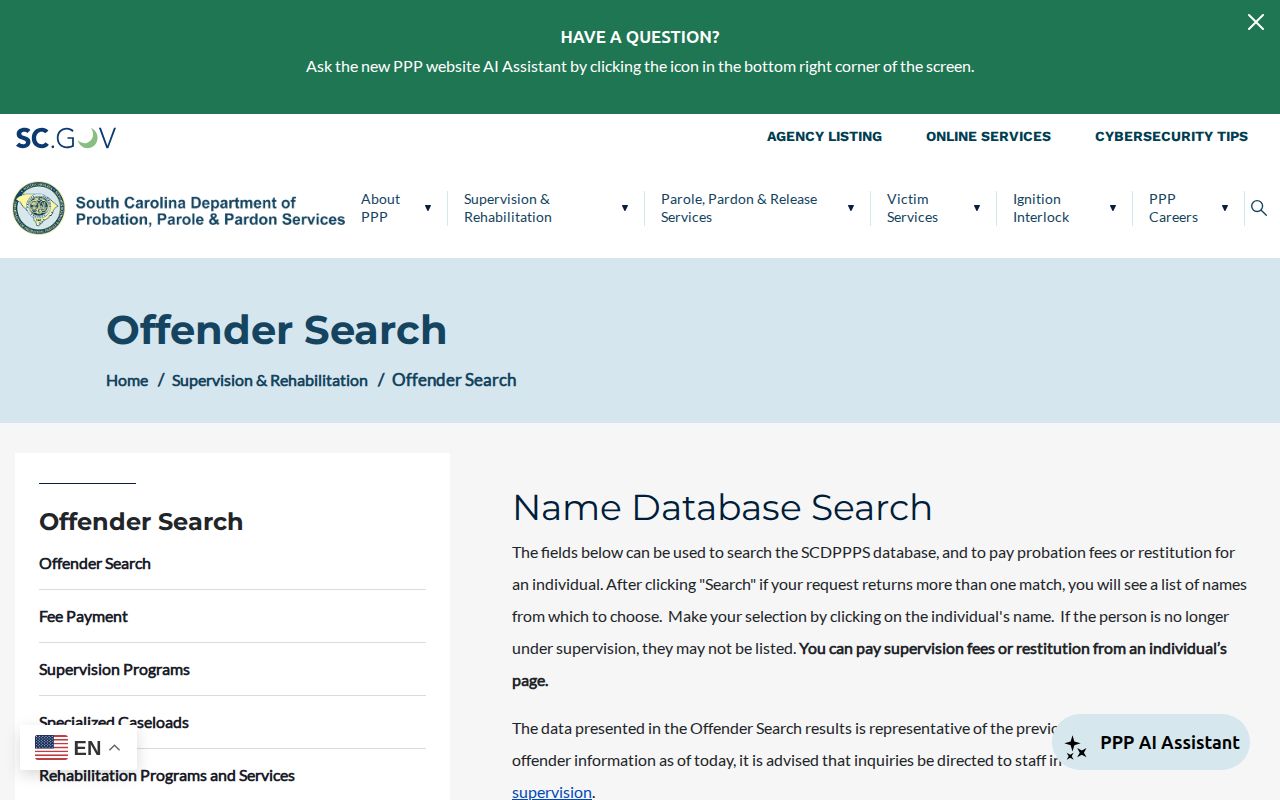
The listed status should be repeated exactly. Probation is a court sentence and need not follow prison. Parole is conditional release granted for an eligible state sentence. Community supervision is a separate statutory form of control after certain no-parole terms. A discharge means the responsible agency ended the named supervision status.
SC VINE offers another layer. Search by legal name, use a middle initial, date of birth, or offender number when available, and select the matching agency record. The service can send phone, text, email, or TTY notifications. Phone registration uses a four-digit PIN, and calls repeat for 48 hours or until that PIN is entered. Re-register after an agency transfer because an Orangeburg jail registration may not follow the person into SCDC.
The deeper distinction between these categories and the local office route is covered on the Orangeburg County Post-Release Supervision page.
Note: A VINE alert reports a participating agency event, while the underlying release sheet remains the official administrative record.
Orangeburg Release Court Checks
The South Carolina case-search gateway can show charges, events, disposition, and sentence entries after Orangeburg County is selected. General Sessions handles felony and other major criminal matters. Magistrate courts handle many summary and preliminary matters, while some municipal records may remain in a municipal system. Search the correct court and compare identifiers. A calendar entry shows a future proceeding, not custody status.
Federal and immigration cases require different tools. The BOP inmate locator searches by federal identifiers or by name with age, race, and sex. A past Release Date with Location listed as RELEASED proves departure from BOP custody at that event. It does not rule out supervision, local custody, immigration custody, or a later case. ICE’s detainee locator uses an A-number with country of birth or exact biographical data and includes a limited window for people released from ICE custody.
No BOP institution or official ICE detention center was verified in Orangeburg County. These are conditional paths. If the county jail released a person to an ICE detainer, the event was a transfer into immigration custody, not community release. Ask Sheriff Records for the receiving agency and then use that agency’s system.
Orangeburg Released or Still Held
The right system depends on the last proven custody status. Use a live locator to test current custody. Use an administrative release record or the dedicated released-person database to prove that agency’s custody ended. Court and supervision records add legal context but do not replace the release event.
| Question | Correct Orangeburg or agency channel | Main limit |
|---|---|---|
| Still in Orangeburg jail? | Detention phone and Inmate Status line | No verified public county roster or detail page |
| Released from Orangeburg jail? | Booking/release sheet, destination question, VINE, and court | VINE and court are corroboration, not the certified jail sheet |
| Currently in state prison? | SCDC current inmate search | Excludes discharged prisoners and county detainees |
| Released from SCDC? | SCDC Released Inmate Search | Does not cover county-jail releases |
| Under supervision? | SCDPPPS offender search and county office | Prior-day snapshot; completed supervision may vanish |
| Federal or immigration status? | BOP locator or ICE detainee locator | Each covers only its own custody system |
A single person can move through more than one row. For example, an Orangeburg County booking may end in an SCDC transfer, followed later by an SCDC release to community supervision. Keep the dates, identifiers, and custodian names tied to each event. That sequence prevents a county transfer date from being mistaken for the later state-prison release date.
Getting Home After Orangeburg Release
Cross County Connection runs two color-coded routes in downtown Orangeburg, with about one hour for a full run. The published fare is $1 each way, or $0.50 for riders age 60 or older and riders with disabilities. It operates on weekdays and does not run on weekends or designated holidays. A Thursday connector also serves St. Matthews.
No reviewed map confirms a stop at the Ellis Avenue detention center. Check the current route maps and schedules or call 803-531-1302 before making a pickup plan. Release processing can finish after service hours, and weekend releases require another plan. Transportation details do not confirm release, so first obtain the actual out time from the jail.
Orangeburg Release Facility Names
Orangeburg County has one active local detention facility with two official names still in use. Current county procurement calls it Orangeburg County Detention Center and says Orangeburg County became sole owner after the regional commission dissolved in 2012. The county FAQ and SC SAVIN still use Orangeburg-Calhoun Regional Detention Center. Those labels refer to the same working facility, not two jails.
The historic jail at 44 St. John Street, often called the Pink Palace, is a National Register property. It is not an operating custody center and has no current release desk. All present detention and release questions belong at the Law Enforcement Complex on Ellis Avenue. The Orangeburg County Detention Center page gives the facility-specific confirmation route.
Orangeburg County Detention Center holds local pretrial and other locally confined populations. A community release should appear in its administrative record. A transfer to SCDC or another government body requires a shift to the receiving agency’s locator. No SCDC prison, BOP institution, or official ICE detention facility was verified within Orangeburg County, so the facility list has one active entry.
Note: The regional and county detention-center names describe one current facility, while the Pink Palace is solely a historic site.