
Orangeburg Parole and Probation
South Carolina assigns several kinds of community control to the Department of Probation, Parole and Pardon Services, commonly called SCDPPPS or PPP. Probation is imposed by a court. It may replace incarceration, accompany a split sentence, or follow a local jail term. Parole is a conditional release authorized by the South Carolina Board of Paroles and Pardons for a sentence that is eligible for parole. A state-prison departure labeled PROBATION or COMMUNITY SUPV in the SCDC Released Inmate Search therefore needs more interpretation than the word “released” alone provides.
Community supervision is its own South Carolina category. Under Title 24, Chapter 21, qualifying no-parole sentences can lead to community supervision after prison, generally for up to two years or the remaining sentence period when shorter. Supervised reentry is another PPP program label. Copy the official label from the result. Do not replace it with a more familiar term, because each status comes from a different legal route.
| Status | How it starts | Best verification |
|---|---|---|
| Probation | A court orders community supervision, sometimes without a prison release. | PPP offender search, sentencing record, and Orangeburg PPP office. |
| Parole | The Board grants conditional release on an eligible state sentence. | PPP record, Board hearing result, and SCDC release entry. |
| Community supervision | It follows release on a qualifying no-parole sentence. | SCDC release type and PPP supervision record. |
| Supervised reentry | PPP uses this separate statutory or program category. | PPP’s exact result label and county-office confirmation. |
- Discharge
- The formal end of a custody or supervision obligation, not merely a move between agencies.
- Absconder
- A person alleged to have fled supervision or remained absent without proper permission.
- Revocation
- An official action that can end community release and return a person to custody.
- SID
- A state identification number that helps distinguish people with similar names.
Verify Orangeburg Post-Release Supervision
The official starting point is the SCDPPPS offender search. It accepts specific field combinations, not any mix a user chooses. Valid routes include first and last name, SID alone, first name with year of birth, last name with year of birth, county with SID, or county with first or last name. A common name may return more than one person, so compare the year of birth, SID, county, and case context before selecting a record.
- Open the PPP offender search and use the strongest known identifier. SID is safer than a name alone.
- If searching by name, add year of birth or Orangeburg County in a combination the form accepts.
- Open the correct individual result and preserve the exact supervision category, office, and identifying number shown.
- Remember that the portal represents the previous day. Call the county of supervision for current-day status.
- Compare parole claims with the individual parole hearing search and the SCDC release record.
- Use the Orangeburg court case to confirm probation terms or later violation and revocation entries.
A missing result does not prove that a person was never supervised. PPP warns that people no longer under supervision may not appear. County of supervision can also differ from county of conviction. For a broader release check that starts with the jail, court, and state corrections systems, use the Orangeburg County released-inmate search path.
Note: PPP data represents the prior day, so the supervising county office is the best source for a same-day change.
Orangeburg County Supervision Office
The official Orangeburg County PPP directory names the local agent in charge and provides direct contact information. Call this office when the web result is stale, when an official label needs explanation, or when the listed county does not match the place of conviction. Staff can address current reporting status within the limits of what may be released publicly.
South Carolina PPP, Orangeburg County
Agent in Charge: Kimberly Brantley
Street: 1146 Church Street, Orangeburg, SC 29116
Mail: P.O. Box 842, Orangeburg, SC 29116
Phone: 803-533-6288
Secondary: 803-533-6291
Fax: 803-533-6293
The directory image below comes from the Orangeburg County PPP office page.
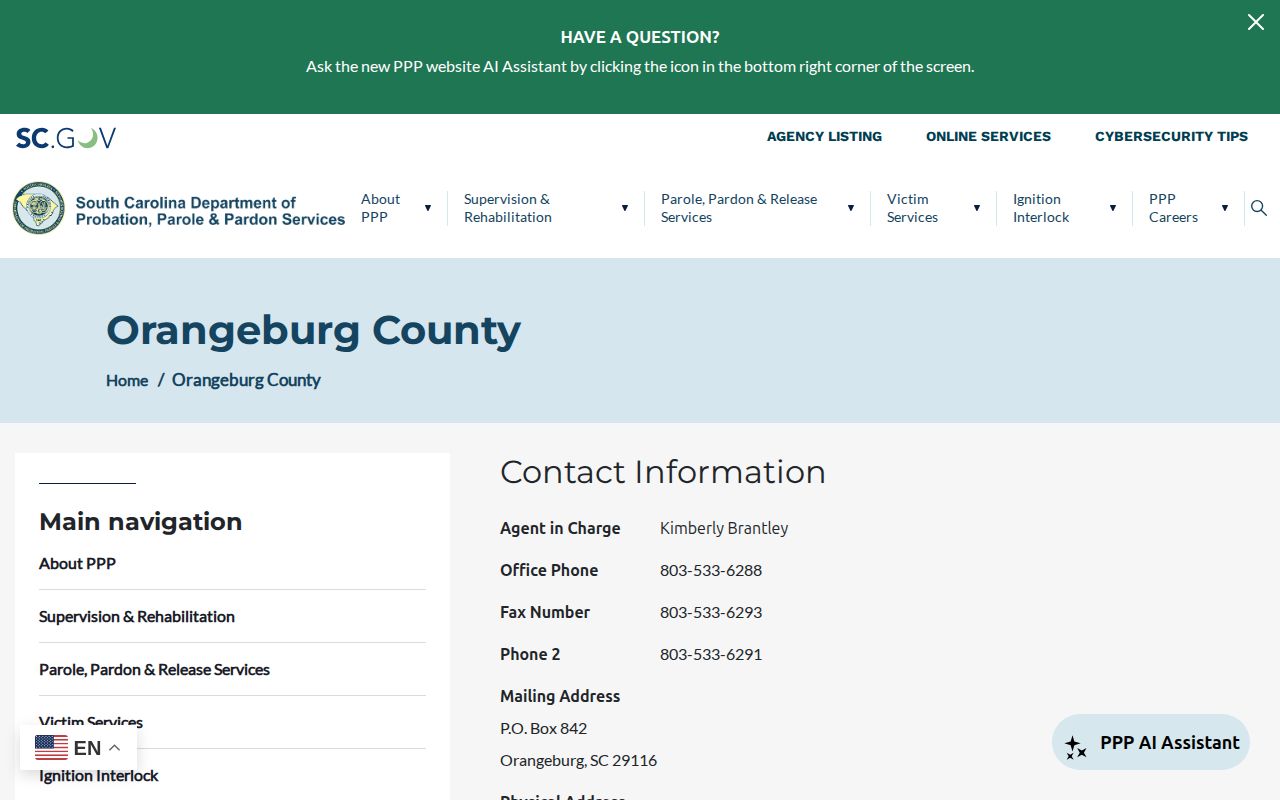
Use the live directory beside the image because the named contact and caseload figures can change.
Orangeburg Supervision Categories
The Orangeburg directory adds useful local detail by separating its jurisdiction caseload into probation, parole, community supervision, supervised reentry, Jessie’s Law tracking, and supervised furlough. On July 31, 2026, it displayed 975 probation cases, 32 parole cases, 46 community-supervision cases, 14 supervised-reentry cases, 10 Jessie’s Law tracking cases, and no supervised-furlough cases. These figures are a dated office workload snapshot. They are not annual releases, the jail population, or the number of people who left custody that day.
The split also shows why a generic claim that someone is “on parole” can be wrong. Most of that dated Orangeburg caseload was listed as probation. A person’s own result controls. The directory totals may help explain office scope, but they should never be used to infer one person’s status. Current figures belong to the live county-office page and should always be read with its date.
Note: Orangeburg caseload totals describe PPP work on one date and do not measure jail releases or prison discharges.
Orangeburg Absconders and Warrants
An absconder allegation means the person may have stopped reporting, left without permission, or otherwise failed to remain in contact. It does not erase the prior release. A warrant or revocation can later return that person to custody, so “released from SCDC” and “currently at large” can both describe different points in the same sequence. Current status should come from PPP and the issuing court or law-enforcement agency.
SCDPPPS also maintains a selective Most Wanted Offenders page. Its cards may show a photograph, county, physical descriptors, original offense, and an AT LARGE or CAPTURED label. An Orangeburg-coded card appeared during research, but this is not a complete absconder or warrant database. AT LARGE says PPP seeks the person in connection with supervision. CAPTURED resolves that alert, but does not by itself explain the underlying case or the person’s present facility.
Orangeburg Release Conditions
Conditions depend on the sentence, Board order, and official supervision plan. They can include reporting, approved travel, treatment, payment duties, monitoring, or other case-specific terms. The public search may show that supervision exists, but it does not replace the written court order or parole certificate. When a condition is unclear, the supervising agent and filed order are the right sources.
A claimed violation also is not the same as a final revocation. PPP may investigate, an agency may seek a warrant, and a court or Board may hold a hearing under the applicable process. Record each stage in its own words. If a person is detained again, use the current custodian’s record to confirm where they are, rather than assuming PPP still has sole control.
Release notifications and supervision records also answer different questions. SC VINE may report a custody change from a participating agency. The PPP search shows an active community-control status in its prior-day data. A court docket may show the filed violation or revocation action. Read together, they can trace a sequence, but one should not be used as a substitute for all the others.
South Carolina’s Board records are relevant only when parole is involved. A hearing result may say granted, denied, continued, deferred, rescinded, revoked, or another official term. Even a grant is not proof of same-day release because planning, conditions, detainers, and SCDC processing may remain. Confirm the later SCDC event and then the PPP status.
The Board hearing search and the PPP offender search also have different time frames. Hearing schedules are generally searchable about 30 days before a hearing, and a date or result can be delayed or changed. The supervision portal is a prior-day view of active community control. A scheduled hearing therefore says that parole is being considered, while a PPP entry says supervision has begun. Neither alone supplies the complete release chain.
When the Board grants parole, its conditions become part of the release framework. When it denies parole, SCDC custody ordinarily continues under the sentence computation unless another lawful event intervenes. Use the result’s own term and date, then check the current SCDC record. This avoids calling a hearing date a release date or treating consideration as approval.
Orangeburg Supervision Discharge
Supervision ends through formal discharge, sentence expiration, or another authorized action. Simply dropping out of the prior-day public search is not enough proof. Ask PPP whether active supervision ended and seek the discharge or court record when written confirmation matters. The SCDC Released Inmate Search can establish an earlier prison departure, while the PPP record addresses the community-control phase that followed.
The clean status sequence is agency-specific: Orangeburg County custody ended, SCDC released the person under an official release type, PPP supervised the person, then PPP discharged that supervision. Each event has a different custodian and record. Keeping those parts separate prevents a transfer, a parole grant, or a completed reporting term from being overstated as full freedom from every legal obligation.
When written proof is needed, identify the record by legal name, SID or SCDC number, court case, and approximate date. Ask PPP for the public discharge record or status confirmation, and ask the Clerk for filed court material. A narrow request is easier to match than a broad request for “all information.” It also reduces the risk of confusing two people who share a name.
Note: A supervision discharge and a prison release are separate events, even when both relate to the same sentence.