
Orangeburg Projected and Actual Dates
A projected release date is a working sentence-computation date. It reflects the terms SCDC expects to be satisfied if the person keeps earning work, education, and good-time credits at the present rate. It is not the same as a scheduled parole hearing, parole eligibility, supervised-furlough eligibility, or the actual moment a jail or prison completes release. Those labels answer different questions and should not be substituted for one another.
County status matters first. An unsentenced person at Orangeburg County Detention Center may remain until an acceptable bond is posted, a court changes the order, the case resolves, or another custodian assumes control. Even a bond order is legal authority, not proof that the jail has cleared every hold and finished out-processing. A locally sentenced person may have a calculable endpoint, but the jail and sentencing court hold the inputs.
- Projected release date
- A date computed from the sentence and current credit assumptions.
- Actual release date
- The date the named custodian records that custody ended or transferred.
- Detainer
- A notice that another agency may seek custody, preventing a simple community release.
- Jail credit
- Time credited toward a sentence for qualifying custody already served.
Find an Orangeburg Release Date
The correct process separates local detention, state prison, federal custody, and immigration custody. Orangeburg’s current jail does not publish a verified online projected-date field. SCDC does provide current-inmate tools with projected-date functions and an automated Victim Services inquiry. The ordinary SCDC public search is for people currently sentenced to and incarcerated in state corrections as of midnight the prior day. It is not an archive for all former prisoners.
- Classify the episode as Orangeburg pretrial/local sentence, SCDC sentence, federal sentence, or another custody type.
- For a local case, obtain the bond or sentencing order from the Orangeburg court and ask the detention center how it is being applied.
- For SCDC, open the current offender search and match the person by SCDC number, SID, name, sentence, and offense context.
- Record the exact live field label and date. Keep projected release, parole eligibility, and furlough eligibility separate.
- Ask SCDC to confirm sentence aggregation and credits rather than applying a general percentage yourself.
- Recheck close to the date and confirm the actual departure through the release record or receiving supervision agency.
The SCDC public inmate search accepts an SCDC number or name, while its broader interface also includes SID and advanced criteria. SCDC Victim Services offers an automated inquiry by offender number, SID, or name for current location and projected release dates. If the person already left SCDC, use the separate Released Inmate Search by date range and county to find the actual release event.
For a county episode, call the Orangeburg detention desk and ask whether the person remains in Orangeburg custody. If not, ask for actual out time, release manner, and destination. The complete named-person process is also set out in the Orangeburg County release search. A transfer date ends one custodian’s control but does not prove community release.
Note: SCDC’s current search and its Released Inmate Search serve different populations and should not be treated as one database.
Orangeburg SCDC Date Fields
SCDC defines Projected Release Date as the date it expects all incarcerated terms to be satisfied if credits keep accruing at the current rate. Its advanced interface can use Projected Release Date Start and End. Projected Parole Eligibility may instead describe expected eligibility or, in some cases, a scheduled hearing date. Supervised Furlough Eligibility is another program date. The live label must be preserved because the source system may revise its interface.
| SCDC field | Meaning | What it does not prove |
|---|---|---|
| Projected Release Date | Expected satisfaction of incarcerated terms under current credit assumptions. | Actual discharge or freedom from all holds. |
| Projected Parole Eligibility | Expected parole-eligibility point or, in some cases, hearing timing. | That parole was granted. |
| Supervised Furlough Eligibility | A separate statutory or program eligibility date. | Final release or discharge. |
| Release Date | An actual SCDC departure shown in the dedicated released search. | That later supervision or receiving custody ended. |
| Release Type | SCDC’s label, such as RELEASED, PROBATION, or COMMUNITY SUPV. | A broad claim that every legal duty ended. |
The SCDC Victim Services page documents automated projected-date inquiry and is shown below.
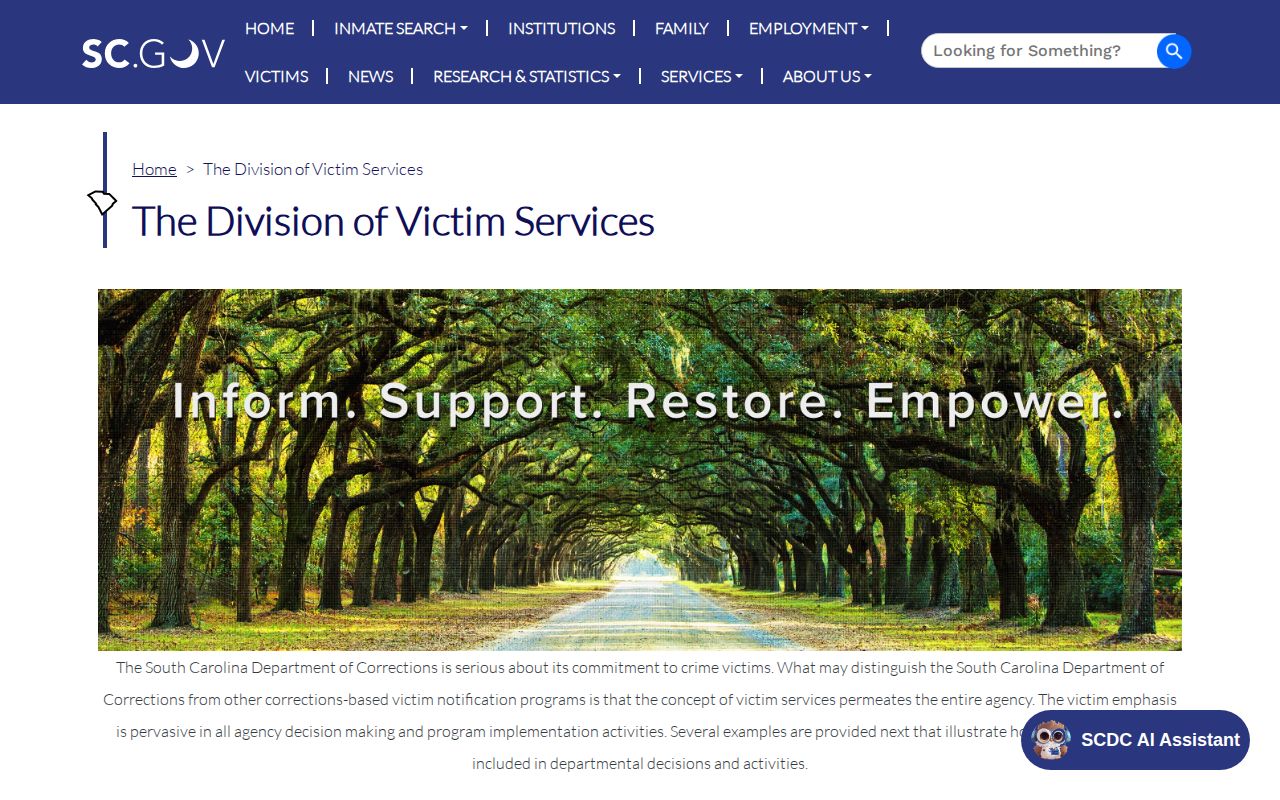
The inquiry is an official way to hear the current projection, but the administrative release record still controls the actual event.
South Carolina Release Credits
South Carolina distinguishes parolable sentences from “no parole” sentences. Section 24-13-100 defines a no-parole offense mainly by felony class and maximum punishment, subject to its full wording. Section 24-13-150 provides that a person serving a covered sentence cannot receive early release, discharge, or community supervision until at least 85 percent of the actual imprisonment term has been served. The suspended part is excluded from that calculation, and credits cannot push service below the statutory floor.
Good-conduct and earned work or education credits are governed by Sections 24-13-210 and 24-13-230. Published SCDC material says qualifying full-time earned work or education credit can reach 15 days per month, or 180 days per year. A no-parole offense is capped at six days per month, or 72 days per year, and those credits still cannot pierce the 85-percent floor. Credit level, sentence date, offense class, concurrent or consecutive terms, and actual participation all affect a real computation.
This is why a headline percentage cannot produce a safe personal release date. Some offenses have distinct rules. Life, murder, and death sentences require separate treatment. Credits can be withheld or forfeited. SCDC must aggregate the actual sentence terms and apply the controlling law, policy, jail credit, and disciplinary record.
Orangeburg Local Jail Credit
South Carolina law treats an eligible local sentence differently. Section 24-13-210 states that a person sentenced to a local detention facility or county public works may receive one day of good-conduct credit for each two days served, conditioned on faithful observance of rules. The responsible local official may forfeit all or part of that credit after an institutional offense or rule violation.
That statewide baseline does not reveal Orangeburg’s person-specific result. The computation still needs the sentence start, prior jail credit, the exact order, any simultaneous cases, forfeiture decisions, and processing facts. Orangeburg County did not publish a separate county formula, a weekend-advance rule, a holiday-release rule, or a physical release schedule in the sources reviewed. None should be imported from another county.
Ask the Clerk for the sentencing sheet and related docket entries. Then ask Orangeburg County Detention Center how the order and jail credit are reflected in its calculation. If another warrant or a state transfer applies, the local endpoint may become a receiving-custody date rather than a community release.
Note: South Carolina supplies a local-credit baseline, but only Orangeburg’s jail and sentencing court can confirm the inputs.
Orangeburg No-Parole Release Dates
The phrase “no parole” does not mean a date can be found by multiplying every sentence by 85 percent. Section 24-13-100 defines the covered offense group through felony class, authorized punishment, and statutory exceptions. Section 24-13-150 then sets the minimum-service rule for that group. The offense of conviction, sentence date, suspended portion, and any offense-specific law all have to be known before the framework can be applied.
SCDC’s projection incorporates the terms it is administering and the credits recognized in its records. Qualifying no-parole prisoners receive far less credit than some eligible parolable prisoners, and the credits cannot reduce service beneath the statutory floor. A disciplinary loss may move the displayed projection later. Continued work or education credit at the present rate is an assumption in the projection, not a guaranteed future fact.
Reaching the SCDC release date also may begin a new phase. Section 24-21-560 provides community supervision for qualifying no-parole releases, generally for up to two years or the remaining sentence period when shorter. A Released Inmate Search value of COMMUNITY SUPV can therefore reflect a real prison departure without a full discharge from legal control. Check the PPP result and county office to identify that next status.
Parolable sentences follow a different path. A projected parole-eligibility field or hearing date does not promise a Board grant. The Board record, SCDC computation, and actual release entry must be read in sequence. Offense-specific exclusions and minimum terms make a single universal service fraction unsafe for parole cases too.
For an Orangeburg conviction, obtain the sentencing order and filed amendments from the court. Use the SCDC number and SID to ask corrections about aggregation, jail credit, and the field shown in the live record. This source-based method explains the displayed date without producing an unofficial personal calculation.
Why Orangeburg Release Dates Change
A projection changes when one of its legal or factual inputs changes. Some changes move the date later, while others alter the release path instead of the date itself. A parole grant, for example, still requires planning, conditions, detainer review, and SCDC processing. A favorable court order may also leave another hold in place.
| Factor | Possible effect | Confirm with |
|---|---|---|
| Good-time or earned-credit loss | Moves a projected SCDC or eligible local date later. | SCDC or Orangeburg jail computation record. |
| Credit earning or level change | May change the pace at which the term is reduced. | SCDC’s current projection and credit record. |
| Detainer or outside warrant | Can convert expected community release into transfer. | Releasing and receiving agencies. |
| Court amendment or jail credit | Changes the sentence inputs. | Orangeburg court order and custodian calculation. |
| Consecutive or concurrent terms | Changes sentence aggregation and the endpoint. | SCDC sentence computation. |
| Parole decision | May authorize conditional release, but not instant departure. | Board result, SCDC, and PPP. |
Confirm Orangeburg Actual Release
Recheck the source near the projected date. For an SCDC sentence, compare the current search, Victim Services inquiry, and later Released Inmate Search result. If the release type is PROBATION or COMMUNITY SUPV, confirm the next status with PPP. A date-range result associated with Orangeburg does not prove the person was held in the Orangeburg County jail, because the released tool’s county is tied to release or destination.
A VINE inmate check can add an alert for a pending event. After the alert, confirm with the agency. For the county jail, request the booking/release sheet with actual out date and time, release reason, authorizing order, and destination. For SCDC, request public release or sentence-computation material by SCDC number and SID when a formal record is required.
The final statement should name what was proven: Orangeburg County custody ended, SCDC released the person to supervision, or another agency assumed custody. “The person is free” is broader than a projected date or a single release record can safely show.